

Consultative selling: what it is and how to train it
Consultative selling explained: what it means, how it differs from transactional selling, what the conversation looks like and how to train a team in it.
- Topic
- Sales
Consultative selling is a way of selling in which the salesperson first understands the customer's situation and the problem behind their request, then recommends only what solves that problem. The salesperson acts as an adviser to the customer. Mack Hanan's book of the same name, Consultative Selling, was first published in 1970.
Most enquiries arrive as a request for something specific. A salesperson can quote for what was asked, or they can ask what the request is for. The second route takes longer and needs more skill, and it is where bigger deals come from.
This article explains what consultative selling means, how it differs from transactional selling, what a consultative conversation looks like and how to train a sales team in it. Consultative selling is what we teach, and the example near the end comes from a client who measured what changed.
What consultative selling means
In consultative selling the salesperson finds out about the customer's world, the problem worth solving and what that problem is costing before they present anything. The recommendation that follows covers only what the customer needs. The customer leaves the conversation feeling properly understood.
You will also hear the terms relationship selling and relationship-based selling. They put the weight on trust built with a customer over time. Consultative selling depends on that trust and adds a structure for the conversation itself, so the two go together.
A review of Hanan's book describes one of the ideas that emerged alongside it: selling should start with understanding the customer's business. That idea is still at the centre of consultative selling.
Consultative selling compared with transactional selling
Transactional selling is taking and fulfilling the order the customer puts in front of you. It is the right approach for simple, low-value purchases where the customer knows exactly what they want. Consultative selling suits purchases where the first request is a symptom of something larger.
| Transactional selling | Consultative selling | |
|---|---|---|
| Starts with | The customer's request | The customer's situation and plans |
| The salesperson mostly | Presents and quotes | Asks and listens |
| The proposal covers | What was asked for | The problem behind what was asked for |
| The customer compares you on | Price | The cost of the problem against the price of solving it |
| Suits | Simple purchases and order taking | Larger B2B sales with several people involved |
Why consultative selling suits larger B2B sales
In a larger sale the person you meet is rarely the only person who decides. Gartner reported in 2020 that B2B buyers typically spend only 17% of their time meeting potential suppliers when they are considering a purchase. Most of the deciding happens in meetings your salesperson is not in.
The person you met has to explain the case to their colleagues without you there. They can only do that if the conversation left them with a clear view of the problem and what it is costing, in their own words. A list of product features does not give them that.
People also decide with emotion and then justify the decision with logic. A consultative conversation gives the buyer both: the trust that makes the choice feel safe and the business case that lets them defend it. Our article on sales psychology and the four phases of a sale explains this in more depth.
What a consultative sales conversation looks like
A consultative conversation has a recognisable order. We teach it as PEPITA®, our six-stage consultative selling model.
- Prepare. Arrive with a point of view about the customer that you can test.
- Explore. Understand their world before you try to solve anything.
- Pain. Find the problem that is worth solving.
- Impact. Help the customer weigh the cost of doing nothing.
- Translate. Connect what you offer to what they need.
- Advance. Agree a clear next step in every conversation.
Our guide in PEPITA® is for the customer to do around 70% of the talking. The page on the PEPITA® sales methodology explains what a salesperson does at each stage.
How to train a sales team in consultative selling
Consultative selling is easy to describe and hard to do under pressure. People can explain good listening and still offer a solution three sentences into the customer's story. Training has to change the habit as well as the knowledge. Our guide to in-house sales training covers how to choose a provider and measure the return.
Practise on your own customers and deals
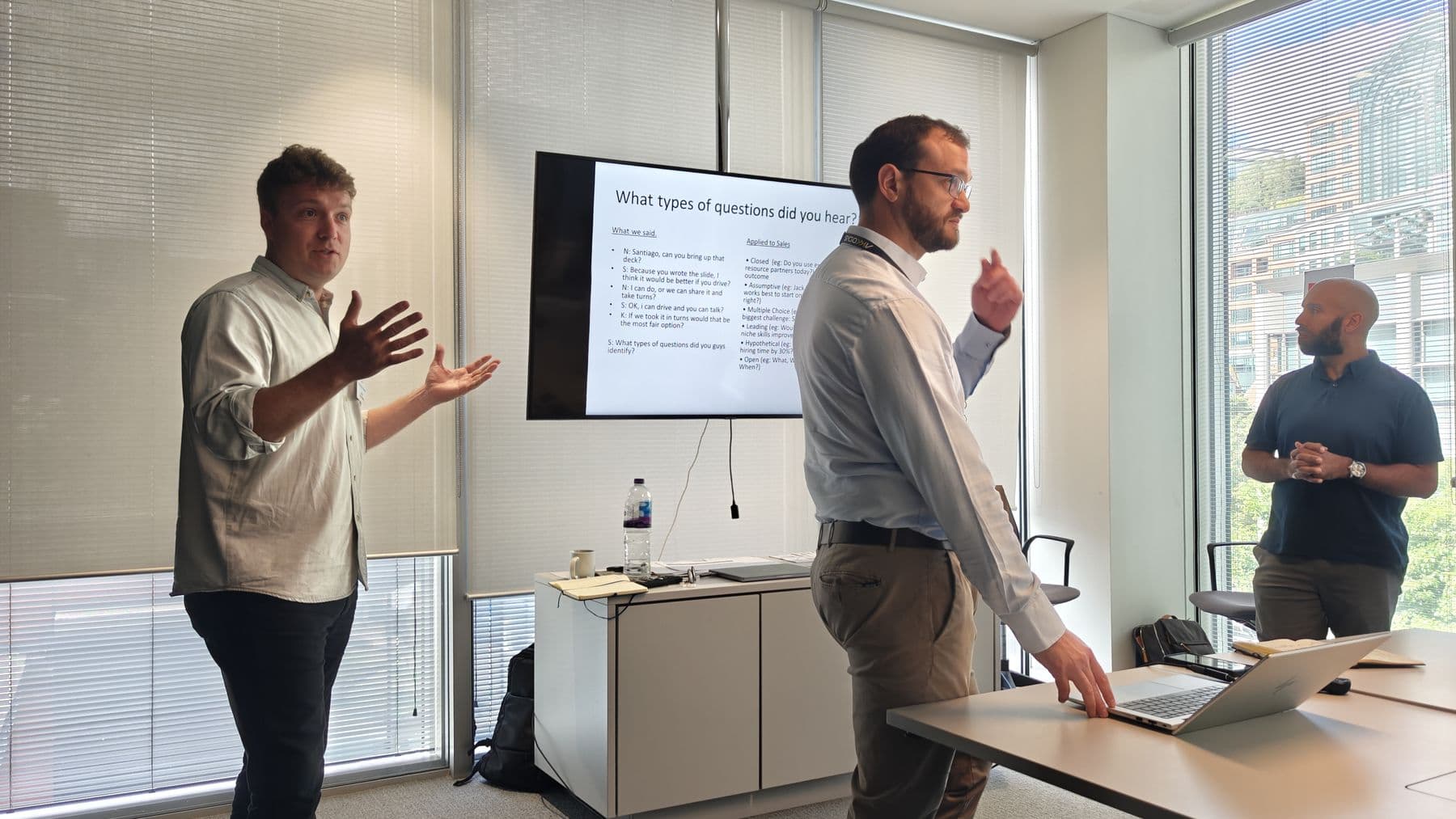
Your team should practise on its own products, buyers and deal sizes. In our consultative sales training the role-plays are designed on the client's real buyers, with structured feedback afterwards against a model conversation. People practise the conversation they had trouble with last week.
Give feedback and a second attempt
Anders Ericsson and his colleagues (1993) studied how people become expert performers. They called the activity that matters deliberate practice and described it as effortful activity designed to improve performance. In sales training we take that to mean a role-play, feedback on what happened and another go.
Spread the training over several weeks
Cepeda and colleagues (2006) reviewed 317 experiments on spacing learning out over time. Our programmes typically run 2 to 4 workshop days across 4 to 8 weeks so that salespeople can use each stage on live deals and bring back what happened.
Give sales managers the same language
The six stages become the questions a manager asks in a deal review. When a deal stalls, working back through the stages usually shows which one was skipped. When the manager keeps asking those questions, the team keeps using the approach after the workshops end.
Teach salespeople to read the buyer's style
A fast, direct buyer wants the headline and the price. A careful, detail-led buyer wants the evidence. We use Everything DiSC, a personality profiling tool, so salespeople can recognise a buyer's style in the first few minutes and adjust to it.
What changed for one sales team
BTL Aesthetics ran a leadership and sales development programme with us over twelve months, in person and virtually. Their Sales and Marketing Director, James Carr, said the team changed how they prepare before meeting a customer and that 62% more of their leads converted into demonstration meetings. The closing rate rose by 12%. The case study sets out the programme, the additional revenue and the 5.5 times return.
Where consultative selling training goes wrong
Three things most often go wrong when a team is trained in consultative selling.
The first is teaching a list of questions. A salesperson who reads out questions about budget, sign-off and timing is running a survey, and the customer stays polite and guarded. The questions land better once the customer has talked about their world.
The second is explaining the approach without practising it. Two habits get in the way when a salesperson is under pressure. We call one the fix, which is offering a solution too early. We call the other the hijack, which is answering the customer's difficult week with a story about your own.
The third is stopping at the workshop. The approach stays in use when the sales manager asks about the six stages in every deal review.
Our consultative sales training is built on PEPITA® and practised on your own products, buyers and live deals.
See the programmeQuestions
What is consultative selling in simple terms?
Consultative selling means understanding the customer's situation and the problem behind their request before recommending anything. The salesperson asks what the request is for, finds the larger problem worth solving and shows the customer what that problem is costing them, instead of simply taking the order.
What is the difference between consultative selling and relationship selling?
Relationship selling puts the weight on building trust with a customer over time, and consultative selling adds a structure for the sales conversation itself. The two go together, because a customer only shares the real problem with a salesperson they trust.
What is a consultative selling model?
A consultative selling model is a set of stages that guides a salesperson through a consultative conversation. Inner Leader's model is PEPITA®, which stands for Prepare, Explore, Pain, Impact, Translate, Advance. SPIN Selling is another well-known model for running the conversation, and our guide to sales methodologies and qualification frameworks compares them.
Is consultative selling right for every sales team?
No, consultative selling suits B2B sales where the customer's first request is often a symptom of a larger problem. It is a poor fit for teams that only take orders and for high-volume telephone sales, where the customer already knows exactly what they want.
Can consultative selling be trained?
Yes, consultative selling can be trained, because the behaviours underneath it are habits that respond to practice and feedback. Inner Leader trains it in-house for B2B sales teams of 6 to 25, typically over 2 to 4 workshop days across 4 to 8 weeks. The role-plays are built on the team's own products and buyers.

Bring this into the room.
Tell us what's going on with your team. If we're not the right fit, we'll let you know. We reply within one business day.