

Sales psychology: the four phases of a sale
Sales psychology explained: what happens in a buyer's head from first contact to signature, and the six fundamentals every sales team should know.
- Topic
- Sales
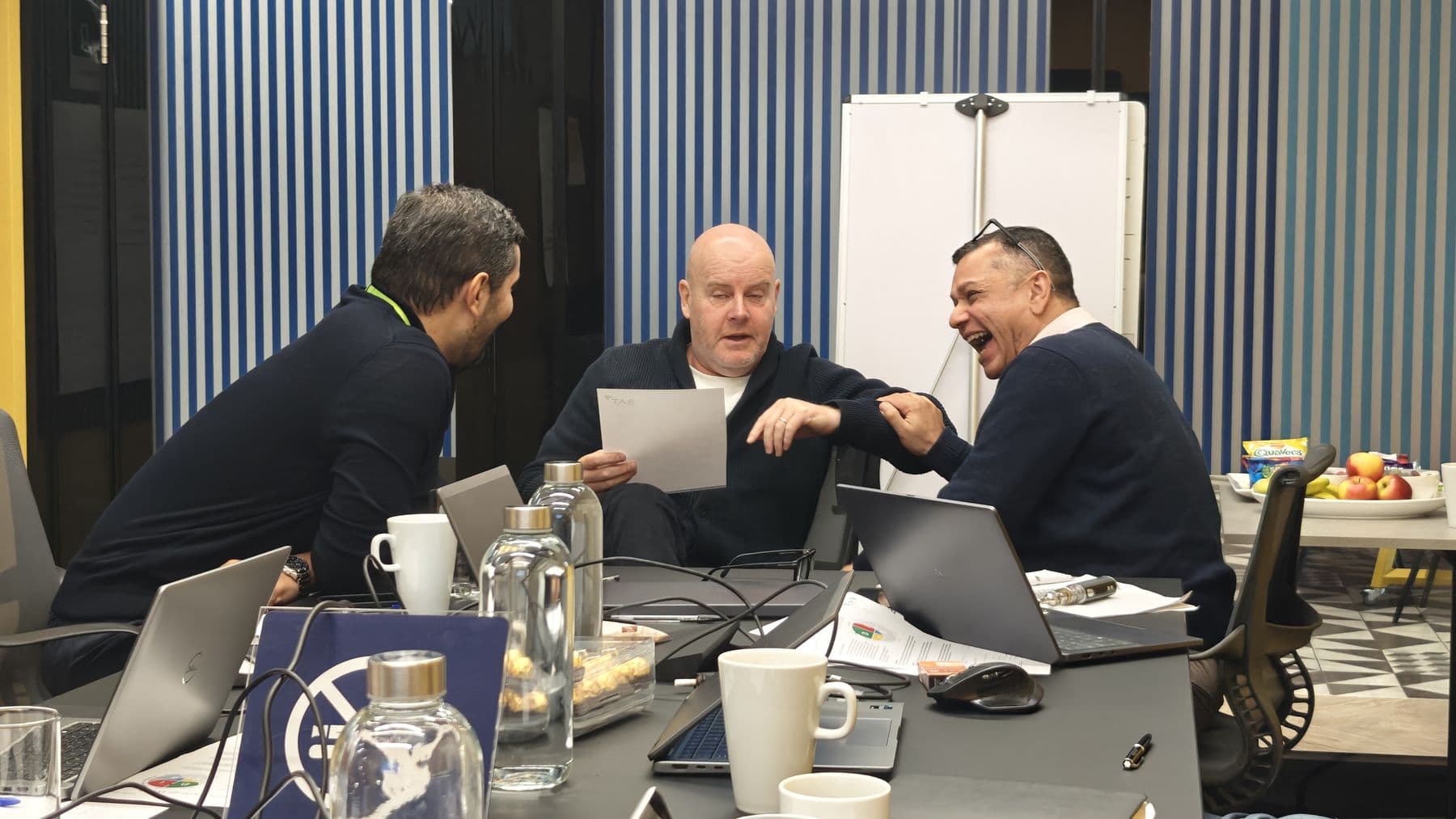
Every buying decision is made by a person. That person has a boss, a budget, a bad quarter behind them and a reputation to protect. Sales psychology is the study of what is happening on their side of the conversation: how they decide, what earns their attention, why they hold back the real problem and how trust is built and lost.
This piece covers two things. First, the four psychological phases a buyer moves through, which is the map. Second, the six fundamentals that decide whether a salesperson helps them move or gets in the way, which is the skill. We have been teaching this in our sales psychology training since 2014, and the examples at the end come from clients who measured what it was worth.
The four psychological phases of a sale
Buyers move through four psychological phases: awareness, interest, decision and action. The phases describe what is going on in the buyer's head. A pipeline stage describes what the salesperson has done. A deal stalls when the salesperson is working one phase ahead of the buyer.
- Awareness. The buyer becomes aware of a need, a problem or a product. At this point they are only noticing.
- Interest. The buyer starts looking for information and forming a picture of what a solution might look like. They are gathering, comparing and quietly ruling things out.
- Decision. The buyer evaluates what they have found and decides whether to buy, from whom and on what terms. Most of the real deciding happens here, often without the salesperson in the room.
- Action. The buyer commits, signs and completes the purchase.
Why the phases matter more than the pipeline stage
A pipeline stage records what the seller has done. A psychological phase describes where the buyer is. The two come apart constantly, and deals stall in the gap.
A salesperson who sends a proposal to a buyer still sitting in interest has asked for a decision the buyer is not ready to make. A salesperson who keeps educating a buyer who has already decided is wasting the one window they had to ask for the business. Reading the phase correctly is the single most useful diagnostic skill in selling, and it is learnable.
How to tell which phase someone is in
Listen to the shape of their questions. In awareness they ask broad questions about the problem. In interest they ask how things work and what the options are. In decision they ask about risk, price, implementation and what happens if it goes wrong. In action they ask about paperwork, timings and who needs to sign.
When the questions go backwards, so has the buyer. A buyer who was asking about contract terms and is suddenly asking again what the product does has usually hit an internal objection you have not heard yet.
The six fundamentals of sales psychology
These are the six we train into every sales team we work with. Each one is a habit that takes practice to hold under pressure.
1. People decide with emotion and justify with logic
A buyer feels their way to a decision and then builds the business case that lets them defend it. This is why a technically perfect pitch can still lose to a competitor the buyer simply trusts more.
The practical consequence is that your job is two jobs. Give the buyer a reason to feel safe choosing you, and give them the material they need to defend that choice to their finance director. Teams that only do the second one lose to teams that do both.
2. Trust is built by listening
Rapport is the buyer's sense that you have understood them accurately. That comes from listening closely enough to play their situation back to them in their own words.
Matching someone's pace, energy and language helps, as long as it is genuine. Buyers spot performance quickly, and once someone feels they are being handled, you rarely get the relationship back.
3. People tell you the stated problem first
Almost every enquiry arrives as a request for something specific. The request is real, but it is usually a symptom of a larger problem the buyer has not articulated, sometimes not even to themselves.
Good discovery goes past the stated request to the problem behind it, the cost of leaving it alone and who else in the business feels that cost. It is also where most sales training stops, because asking those questions well is uncomfortable and needs practice.
4. People buy differently, and most salespeople sell the way they like to buy
A fast, direct buyer wants the headline and the price. A careful, detail-led buyer wants the evidence and the risk assessment. A relationship-led buyer wants to know who they will be dealing with. Give any of them the wrong version and they will conclude you have not understood them.
Most salespeople default to the style they themselves find persuasive. Learning to read someone else's style, and to flex into it without losing your own, is one of the fastest improvements a sales team can make. We use DiSC for this because it gives people a shared language they use afterwards.
5. An objection is information
An objection is the buyer telling you where they are stuck. Answering it with a question keeps the conversation open.
“It's too expensive” can mean the budget is not there, the value is not clear, the buyer is testing you or someone internally has already said no. Those are four different problems with four different answers, and you cannot tell which one you have until you ask. The habit to build is simple and hard: slow down, get curious and find out what is behind the objection before you respond to it.
6. Discounting is the fastest way to lose a negotiation
When a salesperson drops the price early to keep a deal warm, they teach the buyer that the first number was not real. Every later number is then negotiable too, and the conversation moves permanently onto price.
Negotiating on value means knowing what you can trade other than money, and being willing to ask for something in return every time you give something away. This is a skill, and it is one of the quickest to show up in the numbers when a team learns it.
What changes when a team learns this properly
Sales psychology is often taught as theory. It is easier to judge when someone has attached a number to it, so here are two clients who did.
SAP Concur: a discounting habit broken in thirty days
SAP Concur's leadership could see revenue leaking through automatic discounting. Reps were conceding on price early, without asking for anything in return. Fifty-five sales executives across Europe went through a three-module negotiation programme built around their own sales process.
Auto-discounting stopped within thirty days. The sales cycle shortened by 21%, and 92% of the executives reported feeling more confident negotiating on value. In the following twelve months top line sales rose by £480,000, which is 9.6 times what the programme cost. Their Enterprise Head of Sales for the UK and Ireland, Matt Clementson, said the investment paid for itself in a single transaction.
BTL Aesthetics: 62% more leads converted into meetings
BTL Aesthetics had two problems at once. The sales team needed formal training, and a cultural mix of communication styles inside the business was causing misunderstandings that cost time. The programme ran for twelve months, in person and virtually, with personal profiling running through it.
Lead-to-meeting conversion rose 62% and the closing rate rose 12%, worth between £400,000 and £500,000 in additional revenue and a 5.5 times return. Their Sales and Marketing Director, James Carr, described a tangible improvement in the team's approach to work, their internal and external communication and their sales output.
If you want sales psychology training for your own team, our consultative sales training programme covers all of this.
See the programmeWhere teams get this wrong
Three patterns come up again and again.
The first is treating psychology as a set of closing techniques. Scarcity, social proof and reciprocity are real effects, but used as levers on someone who does not trust you they read as manipulation and cost you the relationship.
The second is training the knowledge and not the habit. People can describe active listening perfectly and still interrupt a buyer forty seconds into a call. The gap between knowing and doing closes with practice on live deals, with feedback, over weeks.
The third is leaving the sales manager out. If the manager coaches the way they always did, the team reverts within a month. Whatever the team learns, the manager needs the language to reinforce it.
Questions people ask about sales psychology
What is sales psychology?
The psychology of selling is the study of how beliefs, perceptions and emotional responses shape a buying decision, and how a salesperson can work with those forces rather than against them. In practice it covers how people decide, how trust is built, how objections form and how influence works without pressure.
What are the four psychological phases of sales?
Awareness, interest, decision and action. The buyer notices a need, looks for information, evaluates and decides, then commits. A salesperson's main job is to work out which phase the buyer is in and to move at that pace.
What are the six principles of sales psychology?
The six best known principles come from Robert Cialdini's research on influence:
- Reciprocity. People feel an obligation to return a favour.
- Commitment and consistency. People want to act consistently with what they have already said or done.
- Social proof. People take their cue from what others like them have done.
- Authority. People give more weight to those they see as credible experts.
- Liking. People agree more readily with those they like and feel understood by.
- Scarcity. People value something more when it appears limited.
These describe how influence works. Used on someone who does not yet trust you, every one of them backfires.
What type of psychology is used in sales?
Mainly social, behavioural and cognitive psychology: how people behave in groups, how habits and responses form and how people process information and make judgements under uncertainty.
Why do people buy?
For emotional reasons such as status, security or belonging, for logical reasons such as value or necessity and for social reasons such as what their peers have chosen. Most decisions involve all three, with the emotional reason leading and the logical one used to justify it afterwards.
What are the mental qualities of a successful salesperson?
Empathy, resilience, curiosity, emotional control under pressure, the discipline to listen more than they talk and the willingness to keep practising after they are already competent.
Can sales psychology be trained, or is it personality?
It can be trained. Some people start with more natural empathy or more comfort with silence, but the behaviours underneath all six fundamentals are habits. They respond to practice, feedback and a manager who reinforces them. The SAP Concur and BTL Aesthetics results above came from teams who were already experienced.
How long does it take to see a difference?
Specific habits like holding back on a discount or asking a second question before answering an objection can change within weeks. Deeper changes in how a team runs discovery usually show up over a quarter, because they depend on deals working through the cycle. Both of the programmes above were measured over twelve months.
Bring this into the room.
Tell us what's going on with your team. If we're not the right fit, we'll let you know. We reply within one business day.