

Virtual sales team training: what to cover
Virtual sales training for remote sales teams: what it covers, how a video call differs from a room, how long it takes and how to lead a team you cannot see.
- Topic
- Sales
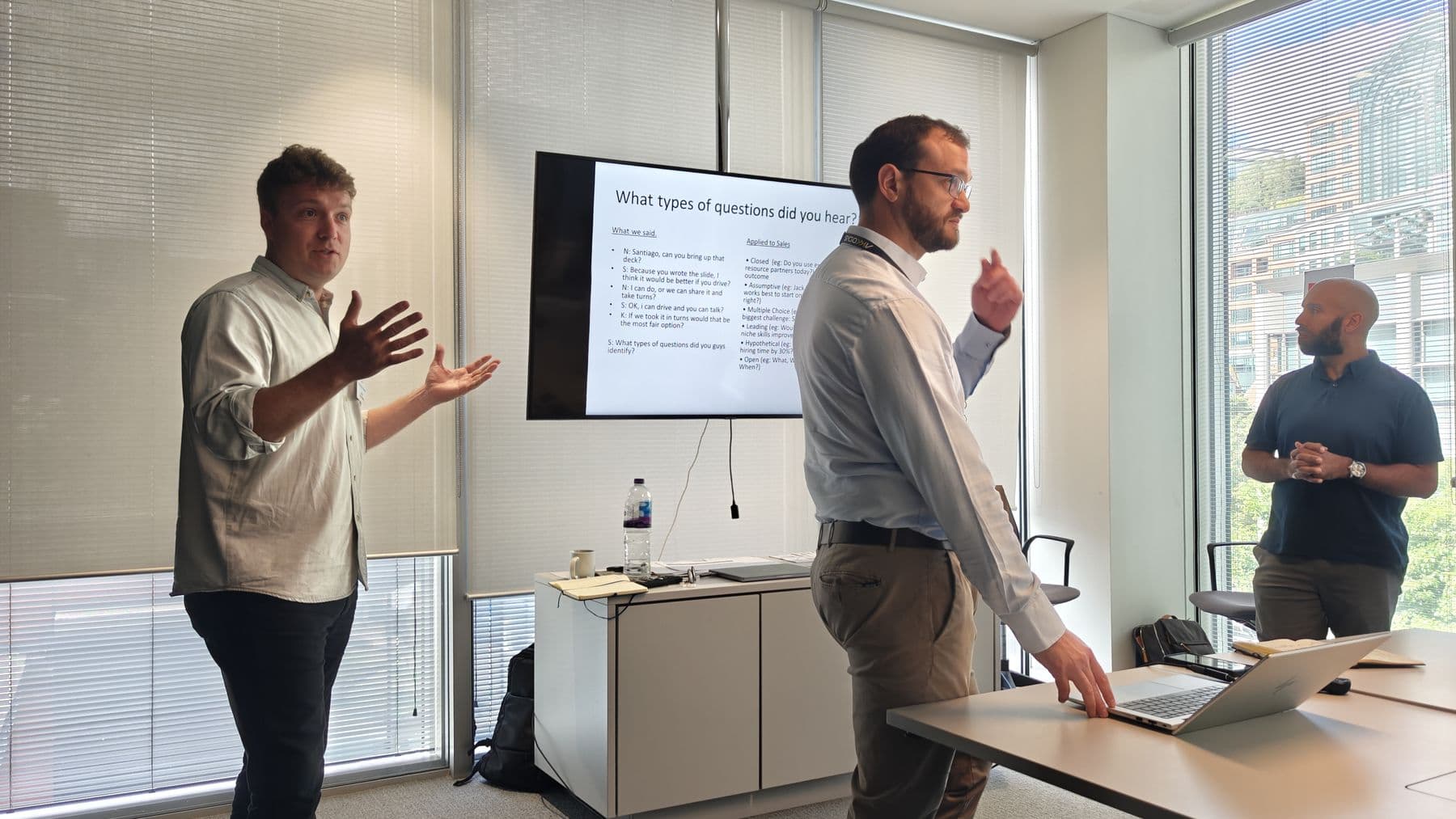
Virtual sales team training is skills training for people who sell over video. It covers how a call is set up, how rapport is built without a room, how to read a buyer through a screen and how to open, close and follow up when the whole relationship runs through a calendar invitation.
Most sales teams now run a majority of their meetings this way, including the ones that close large deals. The people doing it were usually trained for a room, and the skills that made them good in a room translate imperfectly.
This piece covers what changes when a sales call moves to video, what a virtual sales training programme should contain, how to manage a sales team you cannot see and what sales training has been worth to two of our clients.
Inner Leader has been training sales teams since 2014, in person and virtually, across the UK and internationally, and the figures near the end come from clients who measured the result.
What virtual sales training covers
Virtual sales team training, sometimes called remote sales training, is practical training in selling over video. It covers call set-up and presence on camera, building rapport without a handshake or a lunch, reading and sending non-verbal signals through a screen, running a demonstration people stay awake through and handling objections and the close when you cannot feel the room.
It sits on top of ordinary sales skill. Discovery (finding out what the buyer needs), qualification (judging whether a deal is worth pursuing) and negotiation work the same way on video, and the delivery of them has to change. A programme that only teaches camera angles and lighting has skipped the part that moves the numbers.
The format is usually short sessions across several weeks, delivered on the same platform the team sells on, with live call practice recorded and played back. Training people to sell on Teams by putting them in a hotel conference room for a day is a common and expensive mistake.
The measurable outcomes are the ordinary sales ones: meetings booked from leads, conversion from first call to second, average deal size and how often a deal stalls after the demonstration.
What changes when a sales call moves to video
Four things behave differently on a video call, and each one has a technique that compensates for it.
You lose most of the buyer's signals
In a room you can see posture, who glances at whom when a number is mentioned and the person who has stopped taking notes. On a call you get a head and shoulders, often with the camera off. The compensation is to ask directly and often. Checking out loud what someone is thinking becomes the most useful habit a remote seller has.
Rapport has to be built inside the meeting
The relationship used to be built in the walk to reception, the coffee and the lunch. None of that exists now. Rapport has to come from the questions and from curiosity about the buyer's situation, compressed into the first few minutes of a scheduled call.
Attention runs out faster
A buyer on a video call has email open behind the window. Sellers who present for fifteen uninterrupted minutes lose the room without ever knowing it happened. The working rule we teach is to hand the conversation back every three or four minutes, with a real question that needs a real answer.
Silence feels longer than it is
After a price or a difficult question, the pause is the most valuable thing in the conversation. On video it feels unbearable, because there is no body language filling it and a small lag stretches it further. Sellers talk into it and give ground they did not need to give. Holding that silence is a trained skill. Our consultative sales training works on all four of these.
What a virtual sales training programme should contain
The six areas below are what we run. Any credible programme will cover something close to them.
Setting up the call
Camera at eye level, a light source in front of the face, a plain background and a tested connection. This is the shortest module and it removes a category of damage that has nothing to do with selling ability. A seller lit from behind is negotiating from a weaker position than they realise.
Non-verbal communication on camera
Which signals still transmit and how to send them deliberately. Looking into the lens when making a key point, nodding more visibly than feels natural, keeping hands in frame and pausing before answering so the lag does not make you sound like you are interrupting. The team also practises reading what little the buyer gives them.
Rapport and questioning over video
Building a working relationship inside a scheduled half hour. The work is in the questions. Sellers practise going one layer past the stated request to the problem behind it, which is harder over video because the social cost of a probing question feels higher when you cannot read the reaction.
Running the call from open to follow-up
A structure for the call: how it opens, how the agenda is agreed, how a demonstration is broken up, how it closes and what the follow-up contains. Virtual calls punish poor preparation more than in-person meetings do, because there is no corridor conversation afterwards to repair a bad half hour.
Buying signals and objections online
What a buying signal looks like when the only evidence is language and tone. Changes in the shape of the questions, who gets added to the next invitation, how quickly a reply comes back. The team also practises handling objections without a rehearsed rebuttal, which matters more on video where a scripted answer is easy to hear.
Recorded practice and playback
Every programme we run records the practice calls. Sellers watch themselves back, usually once on mute, and find the habits nobody had told them about. This is the part that changes behaviour, and it is also the part providers cut first when a client asks for a shorter programme.
Leading a virtual sales team you cannot see
Training the sellers gets undone by a manager who carries on managing the way they did when everyone was in the office. Four things need changing.
Measuring activity as well as revenue
Revenue lags by a quarter or more, so a team managed on revenue alone gets corrected far too late. Track calls held, second meetings booked and proposals issued alongside it, and reward those while a new approach beds in.
Contact cadence
Weekly contact is too little for a remote sales team. A short daily stand-up (a quick team check-in call) gives the day a shape and surfaces problems while they are still small. Alongside it, a weekly one-to-one that does not get cancelled for a customer call. The cancelled one-to-one is the clearest signal a manager sends about what matters.
Coaching from recordings
The single biggest advantage of virtual selling for a sales manager is that every call can be recorded with consent. Coaching from an actual recording ends the argument about what was said. Listening to two calls a week per seller costs a manager an hour and is worth more than any review of open deals.
Isolation and team spirit
Salespeople draw energy from other people, and a remote team loses the informal part of the job entirely. The teams that hold together put deliberate effort into the social side: an unstructured channel, wins shared publicly and at least one day together in person each quarter. Our piece on leadership for remote and hybrid teams covers the management side of that.
What sales training changed for two clients
BTL Aesthetics: 62% more leads converted into meetings
BTL Aesthetics is a Czech business leading its UK market. The sales team needed formal training, and underneath that a cultural mix of communication styles that people did not fully understand was causing misunderstandings inside the business and in front of customers.
The programme ran for twelve months, in person and virtually, with personal profiling running through it. Lead-to-meeting conversion rose by 62% and the closing rate rose by 12%, worth between £400,000 and £500,000 in additional revenue and a 5.5 times return on the cost. Their Sales and Marketing Director, James Carr, described a tangible improvement in the team's approach to work, their internal and external communication and their sales output. The full account is in the BTL Aesthetics case study.
ITV: what a fully virtual programme achieved
The ITV programme was about coaching skills for senior managers, so the subject was different. It is included here because it answers the question sales directors ask most often, which is whether a programme delivered entirely on video changes behaviour.
It ran virtually from October to March, as four ninety-minute workshops plus two one-to-one sessions each and a closing review. Participants' confidence in coaching others rose by 116%, from an average of 3.7 out of 10 beforehand to 8 afterwards. Every element averaged 9.7 out of 10. The spacing did the work, because short sessions across months gave people time to use something at work and report back. The ITV case study has the detail of how it was built.
If your team sells over video, our sales training helps them build rapport, read buyers and close with confidence on screen.
See the programmeWhere virtual sales training goes wrong
Three patterns account for most of the programmes that produce nothing.
The first is treating it as a technology briefing. A session on lighting, backgrounds and which button shares a screen is useful for about forty minutes. Teams that stop there have solved a presentation problem and left the selling problem untouched.
The second is training the sellers and leaving the sales manager out. If the manager still runs a weekly pipeline review and never listens to a call, the team reverts to old habits inside a month. Whatever the sellers learn, the manager needs the same language to reinforce it.
The third is a single session with no practice. Selling is a set of habits performed under pressure, and habits do not change just because somebody described a better one. Spaced sessions with recorded practice between them are what produce a difference anyone can measure.
Questions people ask about virtual sales team training
What is virtual sales team training?
Virtual sales team training is training in how to sell over video. It covers call set-up, non-verbal communication on camera, building rapport without a room, running a demonstration, reading buying signals from language and tone and handling objections and the close on screen. It is usually delivered on the same platform the team sells on.
How is virtual selling different from selling in person?
Most of the buyer's non-verbal signals disappear, attention runs out faster, rapport has to be built inside the scheduled meeting and silences feel far longer than they are. The underlying skills of discovery, qualification and negotiation are unchanged. How you deliver them has to adapt to a screen.
How long does virtual sales training take?
Four to six sessions of ninety minutes across two to three months, with practice between them, is the format that produces a measurable change. A single day covers the material and changes very little. The spacing matters more than the total hours, because sellers need live calls in between.
Can you train a sales team entirely online?
Yes, and for a team that sells online it is the right choice, because the practice happens in the medium they work in. Our ITV programme ran entirely virtually and raised participants' self-rated confidence by 116%. Most sales programmes still benefit from one day together in person, usually at the start.
How do you build rapport on a video sales call?
Through the questions. Ask about the buyer's situation with curiosity, listen long enough to play it back in their own words and go one layer past the stated request. Small talk transfers badly over video. Being demonstrably interested in someone's actual problem transfers perfectly well.
How do you read buying signals on a video call?
Listen to the shape of the questions. Buyers moving towards a decision start asking about risk, implementation and what happens if it goes wrong. Watch who gets added to the next invitation and how quickly replies come back. When the questions go backwards, an internal objection has appeared that you have not heard yet.
How do you manage a remote sales team without micromanaging?
Agree what gets measured, make it visible to everyone and then spend your contact time on coaching. A short daily stand-up and a protected weekly one-to-one give enough contact. Micromanagement usually appears when a manager has no reliable data, so fixing the measurement removes most of the urge.
What should you measure in a remote sales team?
Calls held, conversion from first call to second meeting, proposals issued, average deal size and cycle length, alongside revenue. The leading indicators matter most, because revenue reports on decisions made a quarter ago and gives a manager nothing to coach this week.
Does virtual selling work for large deals?
It does, and large deals are where the technique gap shows up most. Complex sales involve more stakeholders, and video makes it easier to get them all into a meeting and harder to tell what any of them think. Teams closing large deals use video for most meetings and meet in person at the decision points.
What tools does a remote sales team need?
A single communication platform, a CRM (the system that records customer contacts and deals) the team actually updates, call recording with consent and scheduling that removes the back and forth over times. Keep the stack small. Every tool that adds administration takes time away from selling.
Bring this into the room.
Tell us what's going on with your team. If we're not the right fit, we'll let you know. We reply within one business day.